
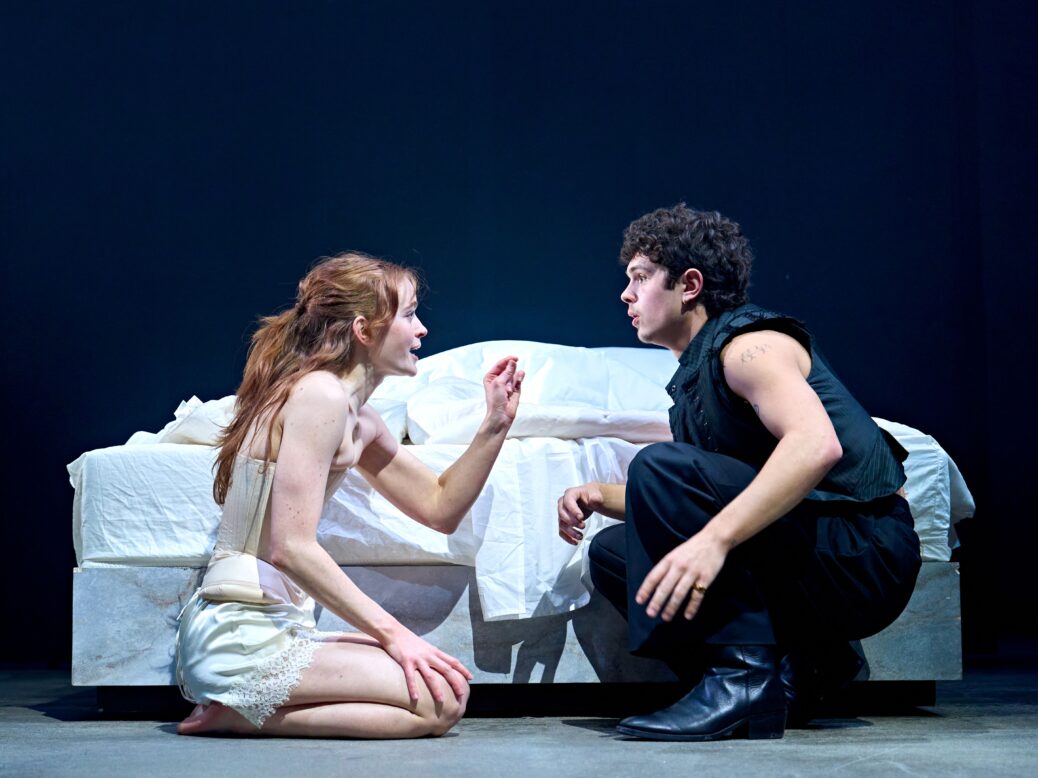
When most people first encounter Romeo and Juliet, in the tumultuous years of adolescence, the play can seem an unjust portrayal of youthful love. How little these controlling parents understand this devoted couple; how sparing they are in their sympathy, dismissing the lovers as children incapable of grasping the depth of romance. To young readers, such incomprehension appears to be maturity’s greatest failing.
In adulthood, however, those teenage convictions come into sharper focus – these children, we begin to feel, should have heeded their parents. Robert Icke’s reimagining at the Harold Pinter Theatre seeks to return the audience to that adolescent disorientation: to make them feel, once again, the perplexing incomprehension of adulthood. In this, he succeeds on a monumental scale.
Such a feat depends on scrupulous casting. Noah Jupe as Romeo convincingly inhabits the petulant, histrionic temperament of the young Montague, rendered with humour both exasperating and engaging. Sadie Sink, however, is the undeniable star. She demonstrates exquisite command of physical expression, her “hand acting” (they fly in the air, tug at her hair, scrunch in frustration) capturing the cadences of adolescent femininity with striking precision. On stage, she is giddy and mercurial, alive to every flicker of feeling – leaping with delight at her first kiss, only to recoil moments later in self-conscious embarrassment.
Clare Perkins is an endearing, matronly nurse, while Kasper Hilton-Hille’s mooning Mercutio – a bum-flashing, camp, boozy, hypersexualised portrayal – verges on excess (one less bum flash might have sharpened its impact), yet for anyone familiar with the chaos of teenage boys, it is an entertaining interpretation. Clark Gregg delivers a tormented Capulet, deftly balancing patriarchal rigidity with fleeting empathy.

However, these thrilling performances are often undermined by ill-considered choices in lighting and sound. The arbitrary insertion of The Boomtown Rats’ “I Don’t Like Mondays” confuses and unsettles audiences, and the inclusion of a Big Thief track feels unnecessary in a play already saturated with guilt, grief, and tragedy. Icke punctuates the production with a looming alarm clock that beeps like a vital signs monitor throughout – a wholly superfluous addition to a play already defined by its compressed timeframe.
Where irritation verges on the unbearable is in lighting designer Jon Clark’s use of sudden explosions of white light to mark the “what could have happened” scenes. For a production likely to draw audiences in the over-50 bracket, a word of caution: a pre-show check-in with one’s GP might be advisable – these strobe-like flashes are not merely blinding, they are positively assaultive, and the accompanying volume threatens to rattle the very bones.
Like set designer Hildegard Bechtler’s garish alarm clock, they hammer home that this is a play obsessed with sliding-door moments, quite literally enacted on stage. If attendees were somehow unaware of this, one might begin to question the standard of English education in this country.
This tendency reaches its apex in the final scene, where Juliet and Romeo awaken to replay the life they might have had: a baby is swooped in, and older versions of the leads shuffle in front of the audience, slow-dancing with their younger selves. For a play teeming with violent, thrilling delights, it is ultimately undone by violent, unnecessary ends.
[Further reading: Johannes Radebe makes Kinky Boots dazzle]
Content from our partners



Related


Join the debate
Subscribe here to comment